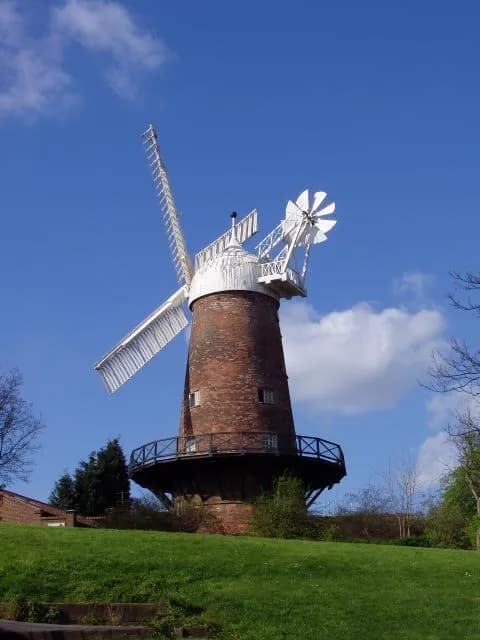
On a hill overlooking Sneinton, a restored brick windmill stands as testament to one of Nottingham's most remarkable minds. The tower mill, built around 1807 by baker George Green senior, would become both workplace and unlikely backdrop for his son's revolutionary contributions to mathematical physics.
A Mill on Belvoir Hill
Green's Mill rose on Windmill Lane in Sneinton, then a village on a ridge about a mile east of Nottingham's centre. The tower mill replaced an earlier post mill on the same site and began grinding flour shortly after its construction. George Green senior established the mill to supplement his baking business, never anticipating that his son would one day be remembered not for flour but for formulae.
George Green was born on 14 July 1793 in Sneinton and baptised the same day. His formal education lasted barely a year. At age eight he attended Robert Goodacre's Academy for approximately eighteen months, where the curriculum included access to "philosophical instruments" such as an electrical machine and an orrery. These early encounters with scientific apparatus may have sparked something in the young Green, though he left school at nine to work in his father's bakery.
The Library That Changed Everything
Green's true education began in adulthood. Around 1823, at age thirty, he became a member of the Nottingham Subscription Library, now Bromley House Library in Nottingham's city centre. This subscription gave him access to the Philosophical Transactions of the Royal Society, the cutting edge of scientific knowledge at the time.
Working days at the mill and studying nights from borrowed volumes, Green taught himself advanced mathematics. The Nottingham Subscription Library provided the only formal intellectual community he would know until much later in life. The library maintains a room dedicated to Green today, honouring the man who used their shelves to change the course of physics.
The Essay of 1828
In 1828, at age thirty-five, Green published An Essay on the Application of Mathematical Analysis to the Theories of Electricity and Magnetism. The seventy-two-page pamphlet was printed at his own expense and sold by subscription to just fifty-one people. The work introduced what are now called Green's theorem, Green's function, and the concept of "potential" in physics.
The Essay lay largely ignored for nearly two decades. Green continued operating the mill, which he inherited upon his father's death in 1829. He and his partner Jane Smith, who took the name Green though they never married, raised seven children in Sneinton. All but the first child were baptised with Green as a surname.
Cambridge at Forty
In 1833, at the age of forty, Green did something extraordinary even by his standards: he enrolled at Gonville and Caius College, Cambridge. His academic career proved brief but brilliant. He graduated in 1838 as Fourth Wrangler, meaning he placed fourth in the university's final mathematics examinations. He was elected a fellow of the Cambridge Philosophical Society and published six additional papers on hydrodynamics, acoustics, and optics before his death.
George Green died in Nottingham on 31 May 1841, aged forty-seven. He was buried at St Stephen's Church in Sneinton, a short walk from the windmill that had grounded his days while his mind wandered through mathematical abstractions.
Rediscovery and Recognition
Green's work might have remained obscure had a young William Thomson, later Lord Kelvin, not chanced upon the 1828 Essay in 1845. Thomson was twenty-one and searching for mathematical tools to understand electricity. He tracked down surviving copies through his former tutor William Hopkins and arranged for the work to be published in Germany's Crelle's Journal between 1850 and 1854.
The mathematics Green developed became foundational. His functions and theorems underpin modern physics and engineering, from electromagnetism to quantum mechanics. Mathematician E.T. Whittaker later described Green as "the founder of that Cambridge School" of mathematical physics, whose methods influenced Thomson, George Gabriel Stokes, Lord Rayleigh, James Clerk Maxwell, and countless others.
The Mill's Long Decline
After Green's death, the mill passed to other hands. The Green family let it first to Mr Fletcher, then to William Oakland. Competition from steam-powered roller mills eventually rendered windmills obsolete, and Green's Mill closed in the 1860s. Its sails were removed and the tower abandoned.
In 1919, local solicitor Oliver Hind purchased the derelict structure and fitted it with a copper cap to make it watertight. He converted it into a boot polish factory. The industrial use proved nearly fatal: in 1947, flammable solvents used in manufacturing ignited, destroying the roof and leaving the mill a burned-out shell facing demolition.
Restoration and Revival
Nottingham City Council acquired the mill in 1979. Funds were raised with assistance from the University of Nottingham, and the building was renovated between 1984 and 1986 by Thompson's millwrights of Alford, Lincolnshire. The restored mill reopened in December 1986 and is now a Grade II listed building.
Today, Green's Mill operates as Green's Windmill and Science Centre, open Wednesday to Sunday from 10am to 4pm with free entry. The mill produces certified organic stoneground flours, including spelt and wholemeal varieties that have won Soil Association Organic Food Awards. Visitors can tour the working mill, explore the Science Centre's hands-on experiments in electricity and magnetism, and stroll through the community garden.
The centre received the Queen's Award for Voluntary Service in 2017 and won the Charity Governance Awards in 2019. It is managed by Green's Windmill Trust, a registered charity.
Legacy in Nottingham and Beyond
No verified portrait of George Green exists. His memorials are the theorems bearing his name, taught in universities worldwide, and the mill that Nottingham restored. In 1993, the bicentenary of his birth, a plaque was dedicated to his memory in Westminster Abbey, placing him among Britain's most celebrated scientists.
The University of Nottingham named its science and engineering library after him. The George Green Library stands as a permanent tribute to a man who began his education in a subscription library and ended it as one of the most original mathematical minds of the nineteenth century.
In Sneinton, the windmill still turns on windy days, grinding flour much as it did when a miller-mathematician worked below and pondered the invisible forces that bind the physical world together.