Nottingham's Lace Market has transformed from the world's lace manufacturing capital into one of the city's most vibrant creative districts. The area's Victorian warehouses, once bustling with 25,000 workers, now house design agencies, technology firms, and educational institutions.
The Rise of an Industrial Powerhouse
Nottingham's connection to textile manufacturing began in 1589 when William Lee, from nearby Calverton, invented the stocking frame. By the mid-18th century, the city had become the centre of the stocking knitting trade, supported by yarn supplies from Richard Arkwright's Derwent Valley Mills.
The lace industry proper took shape in the early 19th century through a series of mechanical innovations. John Heathcoat invented the bobbinet machine in 1808. John Levers adapted this technology in 1813 to create the Leavers machine, and by 1846 John Livesey had developed the curtain machine. These inventions transformed lace making from a domestic craft into an international export industry during the 1840s.
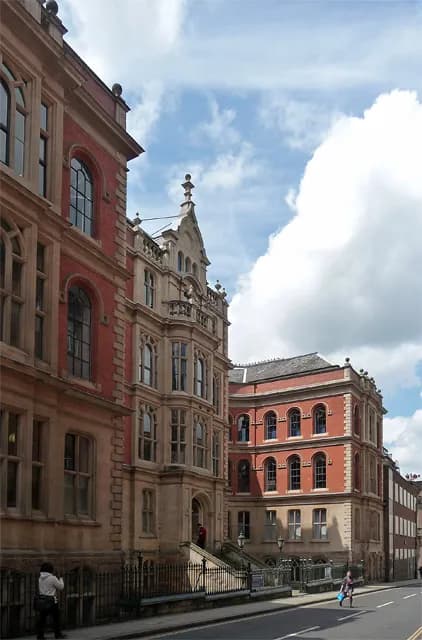
The industry reached its zenith in the 1890s, when Nottingham's hosiery and lace trades employed approximately 25,000 workers, the majority of them women. The Lace Market district filled with distinctive red-brick Victorian warehouses, characterised by large windows and rooftop "lace lofts" where delicate finishing work took place.
Architectural Heritage
The Adams Building stands as the district's most significant surviving structure. Opened on 10 July 1855, this Grade II*-listed warehouse was designed by architect Thomas Chambers Hine for Thomas Adams, a Quaker industrialist. The building encompasses 113,000 square feet across six floors, featuring eight principal staircases and three minor ones. Its most distinctive feature is the innovative "lace lofts" at roof level, where walls are constructed almost entirely from glass to maximise natural light for intricate textile work.
The Lace Market also showcases the work of Watson Fothergill, who designed over 100 buildings in Nottingham between 1870 and 1906. His warehouses, often in Gothic Revival and Old English vernacular styles, display characteristic polychromatic stonework and carved detail.
Decline and Dereliction
The lace industry's collapse came swiftly. By the 1970s, the working population had fallen below 5,000. Many factories became derelict, and the area entered a period of decline that threatened its historic fabric.
The Turnaround: Conservation-Led Regeneration
Nottingham was among the first British cities to recognise the value of its industrial heritage. In 1969, the Lace Market became the city's first conservation area. Nottingham City Council launched "Operation Clean Up" in 1978, offering public grants to building owners prepared to refurbish their historic properties.
The Adams Building restoration marked a turning point. The Lace Market Heritage Trust acquired the building in 1996, and following a £16.5 million restoration project funded by the Heritage Lottery Fund and European Regional Development Fund, it was officially reopened by Charles, Prince of Wales, on 5 February 1999. The project earned New College Nottingham the Queen's Anniversary Prize in 2002.
A New Creative Quarter
Today, the Lace Market functions as a mixed-use creative district. Nearly all historic warehouses have been cleaned and renovated, now serving as luxury apartments, high-specification offices, and academic facilities.
Nottingham College occupies the Adams Building as part of its city campus, offering courses in art and design, fashion and textiles, business, and digital media. The area has attracted public relations and design agencies alongside technology companies. The Nottingham Contemporary arts centre, the National Justice Museum in the former Shire Hall and County Gaol, and the Lace Market Theatre add cultural depth.
Ongoing Development
The regeneration continues. The £58 million Nottingham College City Hub opened in January 2021 as part of the broader Broadmarsh Area Transformation led by Nottingham City Council. The project, delayed from its planned September 2020 opening due to COVID-19, forms part of wider plans that include a new Central Library and improved public realm.
The Lace Market's transformation demonstrates how heritage-led regeneration can preserve architectural character whilst adapting to contemporary economic needs. The district retains its status as a conservation area with numerous listed buildings, ensuring that Nottingham's industrial past remains visible within its creative future.